
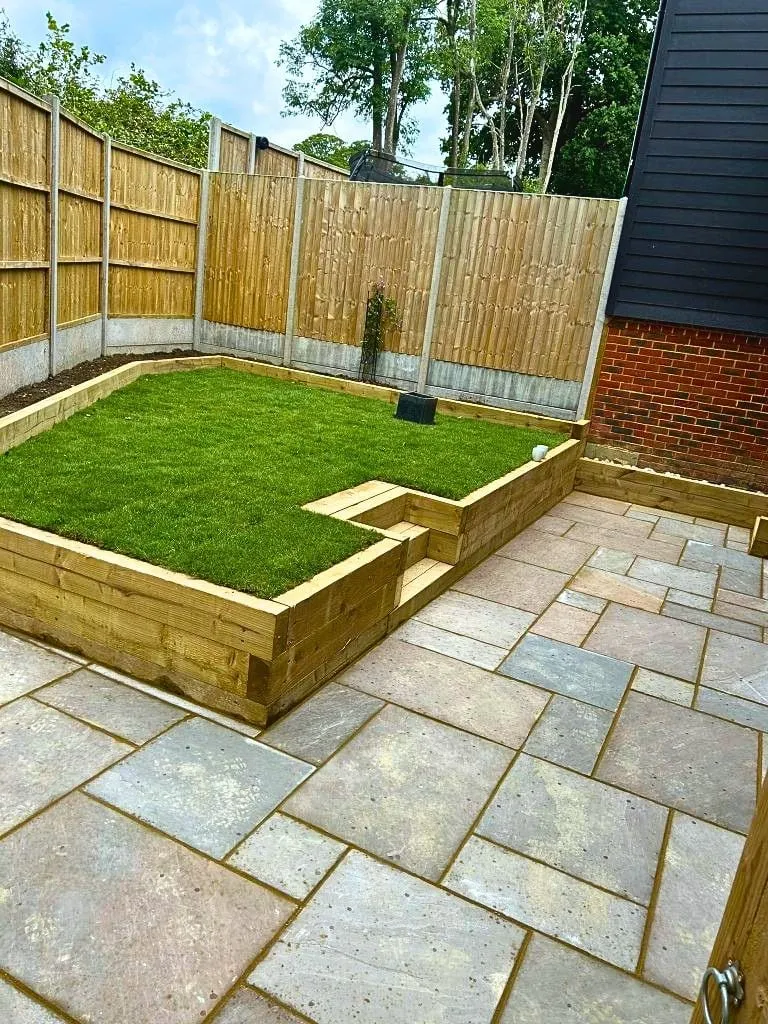
Close Board Fencing: What It Is and Why It Lasts
Close board fencing is one of the strongest timber fences you can put up. Here's how it's built, how it compares with panels and how to make it last.
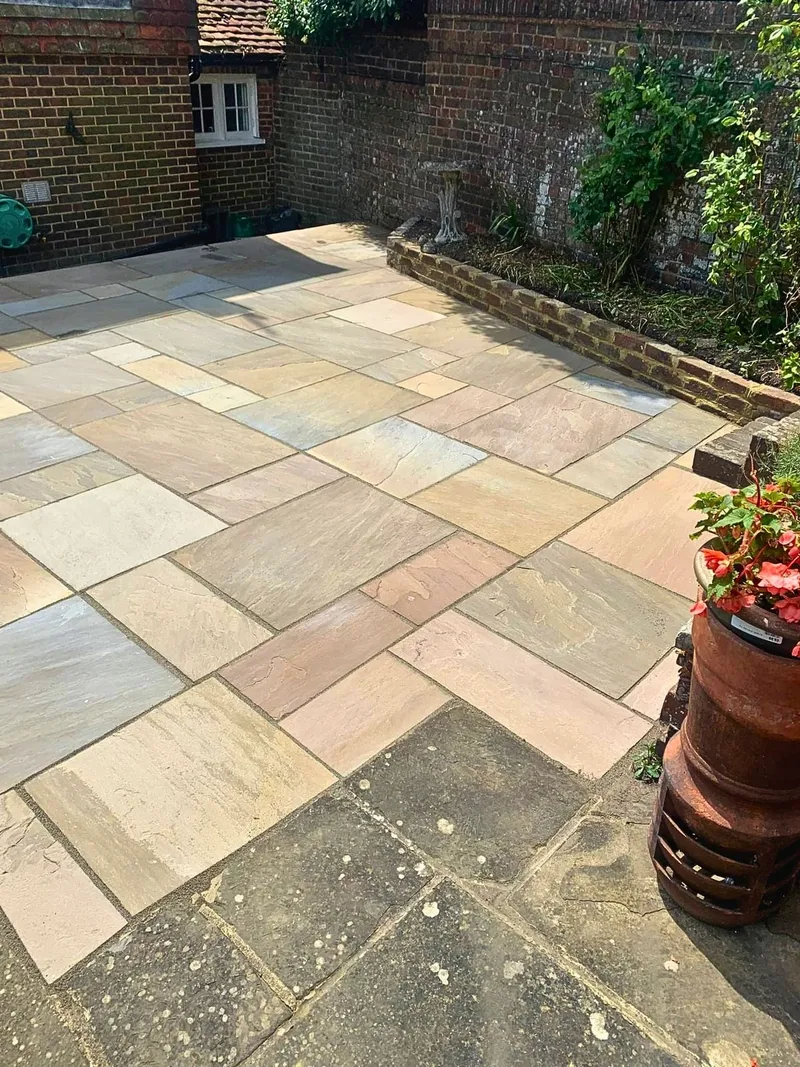
Indian sandstone paving and porcelain paving are the two most popular choices for a new patio. Both last for decades when they're laid properly. Both can look stunning.
The difference comes down to look, upkeep and laying. Sandstone is natural stone with warm, varied colours. Porcelain is man-made, with a crisp, even finish that barely needs cleaning.
Below, we compare the two side by side. Then you can pick the one that suits your house, your garden and your free time.
Indian sandstone paving is natural stone, quarried in India and cut into slabs. Because it's natural, no two slabs are quite the same. You'll see shades of buff, grey, pink and brown. Many slabs carry ripples and fossil-like markings too.
That variety is the main reason people love it. An Indian sandstone patio looks warm and settled from day one. It suits older brick and weatherboarded houses especially well. Around Cranbrook and Tenterden, it's often the natural choice.
Most Indian sandstone paving has a riven finish. The surface is slightly uneven, like split stone, which gives good grip underfoot. Sawn sandstone has a smoother, flatter face and a more modern look.
Porcelain paving is made from fine clay fired at very high temperatures. The result is a dense, hard slab that absorbs almost no water. Many slabs are printed to look like stone, slate or wood, but in a more even way.
Porcelain has crisp, straight edges and a uniform thickness. A porcelain patio suits modern homes and extensions with large glass doors. It also works well in contemporary gardens, where clean lines matter.
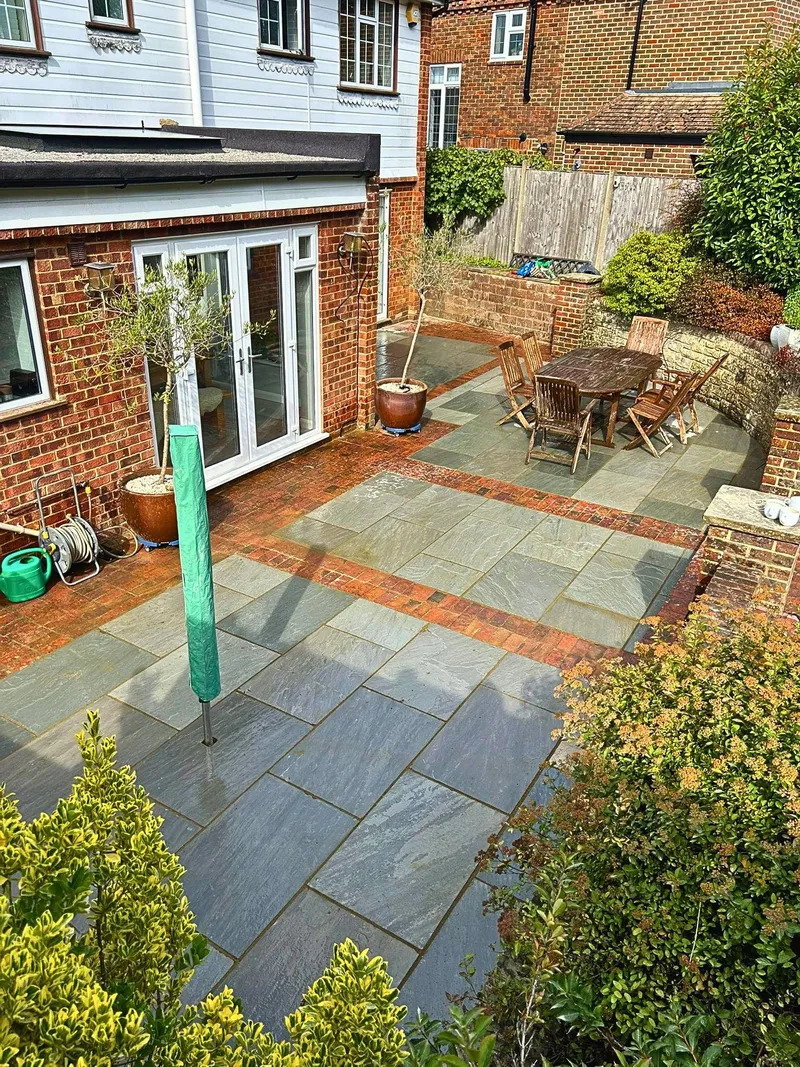
Sandstone is natural and varied, so it looks warm and traditional. Porcelain is even and consistent, so it looks smart and contemporary. Neither is better. It depends on your house and the feel you want.
This is where porcelain stands out. It absorbs so little water that moss, algae and spills sit on the surface. They wipe off easily. Sandstone is porous, so it weathers and can turn green in shady spots. It benefits from an occasional clean, and many people seal it to reduce staining.
Riven sandstone has a naturally textured surface. Outdoor porcelain has a slip-resistant finish, but it can still feel smoother underfoot. That's most noticeable in shade or when wet. Always choose porcelain made for outdoor use, not indoor tiles.
Sandstone mellows as it weathers, and some colours soften in the sun. Porcelain keeps its colour almost unchanged for years.
Sandstone slabs are usually thicker and heavier than porcelain. Porcelain is thinner, at around 20 mm, but very strong for its size. Both are plenty strong enough for a garden patio when laid on a proper base.
Both need the same groundwork. First, the old surface and soft ground are dug out. Next comes a deep layer of compacted sub-base. Then every slab sits on a full bed of mortar, never a few dabs.
Porcelain is less forgiving, though. Each slab needs a priming slurry on the back so it bonds to the mortar. The joints need to be accurate too, because the edges are so straight.
Indian sandstone paving varies in thickness from slab to slab. Laying it well takes patience, so the finished surface is level and every slab sits firm.
Much of the Weald sits on heavy clay, which holds water. Whichever paving you choose, the patio needs a gentle fall. That way rain runs away from the house. It also needs a proper base, so the slabs don't sink when the ground is wet.
If your garden is shady or under trees, porcelain stays cleaner with less effort. If you have an older house or a cottage-style garden, sandstone often looks more at home.
Plenty of people mix the two. Porcelain goes near the house, where it gets the most use. Sandstone paths then lead further into the garden.
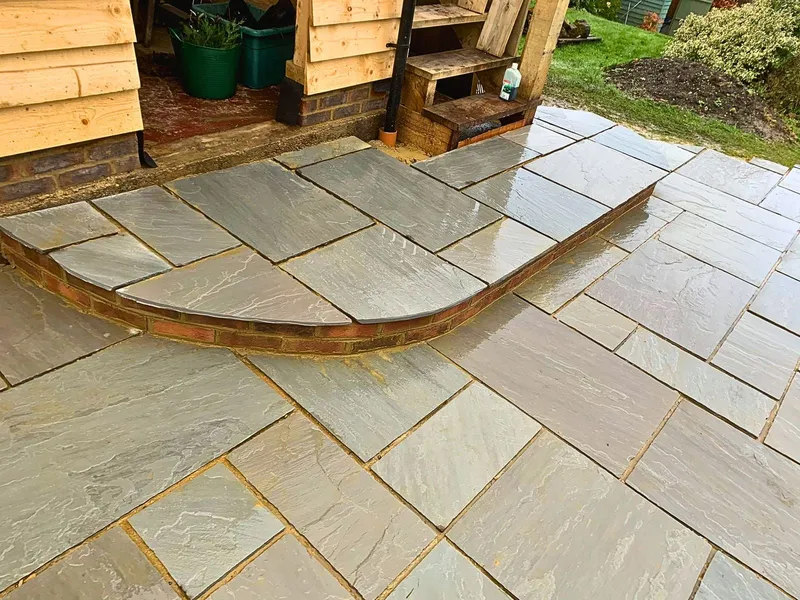
Laid on a proper base, both will last for decades. The paving itself rarely fails. Problems almost always come from what is underneath it.
Indian sandstone paving can flake slightly on the surface over many years, especially softer stones in damp shade. A sealer and an occasional clean help slow this down.
Porcelain hardly changes at all. Its biggest risk is a slab that was never bonded properly, which can work loose. That is why the primer on the back of each slab matters so much.
Whichever you choose, keep the joints full and the drains clear. Those two habits do more to protect a patio than anything else.
The best way is to see both in your own garden. Colours look very different on a shady patio than they do in a showroom.
At your free visit, we bring samples of Indian sandstone paving and porcelain. You can compare them against your house before deciding. See our patios and paving pages for more on how we lay them.
Neither is better overall. Porcelain is easier to keep clean and looks modern. Indian sandstone is natural, warm and varied, and it suits older houses. The right choice depends on your house and how much upkeep you want.
It doesn't have to be sealed, but a sealer reduces staining and makes cleaning easier. Sandstone is porous, so without one it can mark and turn green in shade.
Outdoor porcelain has a slip-resistant finish, but it can feel smoother than riven sandstone. Choose a slab rated for outdoor use and keep it clean.
The groundwork is the same: a compacted sub-base and a full mortar bed. Porcelain also needs a primer on the back of each slab, and more care with the joints.
Joe and his team done a very good job on our garden Indian sandstone patio and very reasonably priced will most definitely use them again for future projects
Had a patio driveway done by Joe and his team recently, cannot fault his work or how professional he was, kept me up to date with everything going on, I now wouldn’t use anyone else for any landscape work, highly recommended, extremely happy!
NEW PATIO. Excellent work for a very reasonable price. Not only polite but very professional, polite and clean and tidy at the end of the working day. I would highly recommend without hesitatition.
My new fencing and patio looks amazing. Excellent work, completed job on time. I would highly recommend.
Joe and the team were fantastic when they turned up and done a patio job for us, would recommend to anyone
Recently had our entire garden renovated with Matt and his team. First of all the entire team were so polite, friendly and respectful of neighbours and keeping everything tidy. Their pricing was very reasonable considering the amount of work we had done. After meeting Matt and having a consultation he went through everything with us in detail and it is clear the level of experience and knowledge he has in his trade, as does he’s highly skilled team. They have completely transformed our garden to our dream garden and the biggest bonus being it was within our budget so we didn’t have to do it in stages as we first thought ! Thankyou - we will be getting you back for the driveway :)
I can not speak highly enough of Joe, Matt and the team, they transformed an ugly wasteland of garden into my little corner of paradise, they were so patient with my dithering and inability to make decisions, they gave excellent advice and nothing was too much trouble. The whole team were polite and friendly. Thank you so much guys.
Matt and the boys were outstanding. He helped me design my small garden to give it the illusion of being bigger. Brilliant paved area with timber sleeper planter around the fence line. They were always on time and produced first class work. I woul highly recommend Matt and the team. Thanks for everything
Joe and his team have done a great job clearing and prepping our garden for future landscaping works. Joe was very patient with our various requests and changes and more than happy to break down the job for us into different stages so we can manage the cost. The lads worked really efficiently, arrived when they said they work and left a very tidy site behind. We will definitely be using Joe and Matt again for future works.
After issues with a previous Landscaper, we found and contacted Joe and Matt. They provided a prompt, detailed and reasonable quote. Their work and approach to our project was professional and of good quality. We thank them for their hardwork and would highly recommend them.
I highly recommend this business for its excellent service, I had a driveway put in, the quality of materials exceeds my expectations the team went above and beyond to provide us with customer satisfaction and loyalty, I was extremely happy with the results. I will be using them again.
Joe and Matt have been great from start to finish. Effective communication, courteous, polite. They got the job done efficiently and left everything tidy. Would definitely use them again.
Great job by JC and sons clearing our back garden of mature shrubs, roses etc and hedge cutting. Done in double quick time and taking everything away.. not a leaf or twig left! Would highly recommend.
Joe, Matt and team were great. They were detail oriented, fast, and made suggestions that gave us a beautiful front driveway. Highly recommend!
Very happy with the work they have completed have used them on a few occasions now and will definitely use again very friendly and can’t do enough for you clean and tidy 👍
I would highly recommend. Very professional and punctual. Rates are very competitive and a professional finish. Well done guys will use you again on my next project
Had in to turf and tidy up my garden top quality work carried out, extra effort to get the top quality finnish on the job
Excellent service and job completed to a very high standard; garden left exceptionally tidy. Great team
Friendly efficient reliable workers .. a great job well done . I would definitely recommend them .
Cannot fault JC Landscapes. Professional, friendly and punctual I would definitely use their services again.
Close board fencing is one of the strongest timber fences you can put up. Here's how it's built, how it compares with panels and how to make it last.
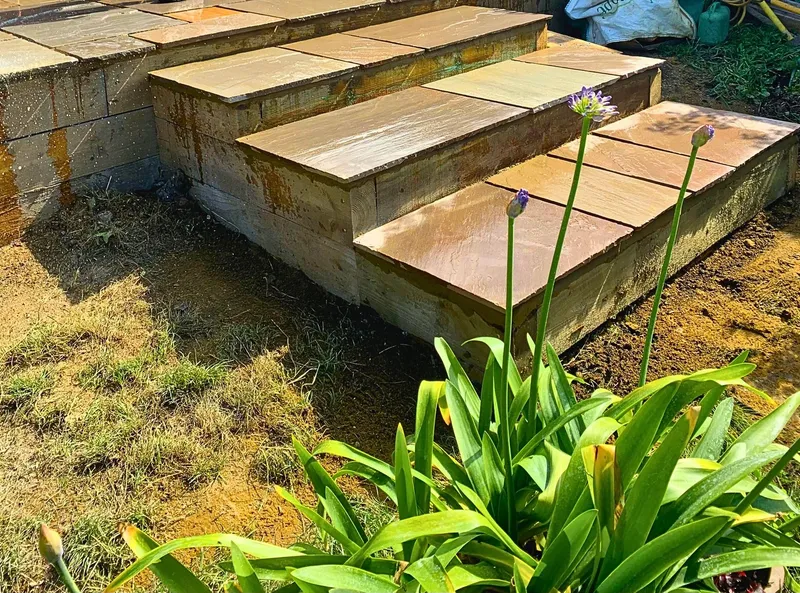
A slope doesn't have to be a problem. Well-planned garden steps make every level easy to reach, and they can be a feature in their own right.
We'll bring samples of both to your home, so you can see them against your house before you choose. Tell us a little about your garden and we'll get back to you within 24 hours to arrange a free visit and quote.
Prefer to talk? Call us on 07828 731270 or email info@jclandscapes-kent.com.